The previous note compared sizes of sets using bijections and injections. This note begins with the first genuinely large-set theorem of the chapter: Cantor's theorem. It shows that every set is strictly smaller than its power set.
That result immediately gives a proof that the real numbers are uncountable. The same pages then move to two foundational statements: the continuum hypothesis and the axiom of choice. The course does not prove their deep metamathematical facts, but it states clearly how they enter the theory.
Power sets and Cantor's theorem
Definition
Power set notation
For a set , the notation denotes the set of all subsets of .
Thus
means exactly that .
The notation is suggestive: if has n elements, then its power set
has subsets. Cantor's theorem says that the power set is larger not only
for finite sets, but for every set.
Theorem
Cantor's theorem
Let be a set. Then
The proof has two parts.
First, there is an injection
So .
Second, there is no bijection from to . Suppose, for contradiction, that were a bijection. Define the diagonal set
Since is a subset of , we have . If f were surjective, there
would be some such that
Now ask whether .
- If , then by definition of , , a contradiction.
- If , then by definition of , , again a contradiction.
Both cases are impossible. Therefore no bijection exists, and hence .
Proof
Why this is a diagonal argument
A diagonal lab
The widget below is meant to support the proof, not replace it. Use it to see how the set is forced to disagree with each attempted list of subsets.
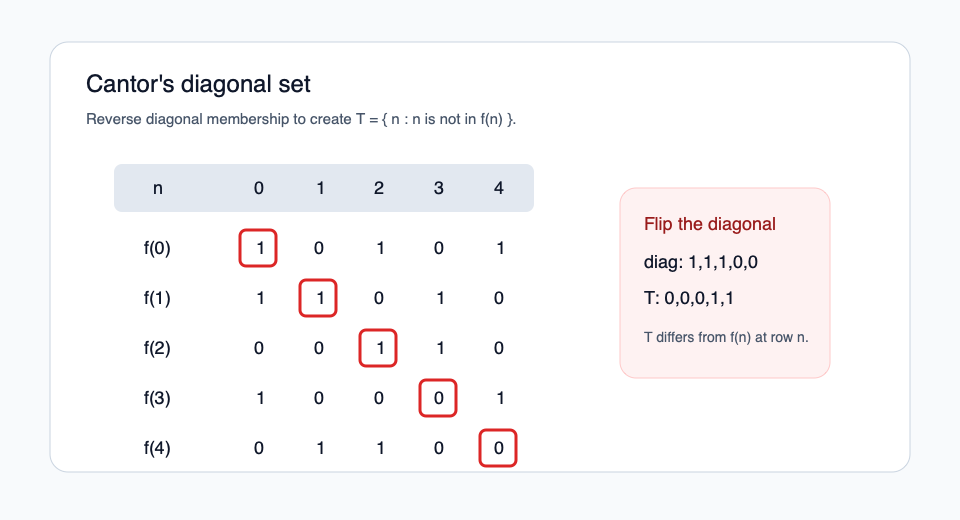
Figure. The diagonal set is constructed by reversing the membership decision on the diagonal, so it cannot equal any row of the proposed list.
Read and try
Build Cantor's diagonal set
The lab turns Cantor's diagonal argument into a table that shows why no list can contain every subset.
| n | f(n) | n in f(n)? | n in T? |
|---|---|---|---|
| 0 | {0, 2, 4} | Yes | No |
| 1 | {0, 1, 3, 5} | Yes | No |
| 2 | {2, 3} | Yes | No |
| 3 | {0, 4} | No | Yes |
| 4 | {1, 4, 5} | Yes | No |
| 5 | {} | No | Yes |
T = {3, 5}
This finite table only illustrates the rule. In the proof, T = {n in N : n notin f(n)} differs from every listed f(n) exactly at row n, so no list can contain all subsets of N.
The real numbers are uncountable
Theorem
The reals are uncountable
The set of real numbers is uncountable. In particular,
The proof uses Cantor's theorem and an injection from into .
By Cantor's theorem,
So it is enough to show
Given a subset , encode it by a sequence of zeros and ones:
Then define
This sends each subset of to a real number.
Worked example
Encoding a subset of N
If
then the beginning of the sequence is
The corresponding real number begins as
The proof does not need to describe this number by a decimal expansion. It only needs the fact that the infinite series determines a real number.
Why use base 3 rather than base 2? Base 3 is useful so that distinct
zero-one sequences cannot be cancelled by the tail.
If , let k be the first index where the two associated sequences
differ. At index k, the two sums differ by exactly
The total possible contribution from all later terms is smaller than that leading difference. Therefore the two real numbers are not equal. Hence is injective, and .
Combining this with Cantor's theorem gives
so is uncountable.
Common mistake
The proof only needs an injection into R
To prove , we do not need every real number to be hit by . We only need distinct subsets of to produce distinct real numbers.
The continuum hypothesis
Theorem
Continuum hypothesis
The continuum hypothesis says that there is no set such that
This is a natural guess after seeing that is larger than : perhaps there is no intermediate size between the countably infinite cardinality and the cardinality of the continuum.
This guess has a surprising formal status. The continuum hypothesis is independent of the usual axioms of set theory, ZFC. Godel showed in 1940 that it is consistent with ZFC, and Cohen showed in 1963, using forcing, that its negation is also consistent with ZFC. Therefore it can neither be proved nor disproved from the standard axioms alone.
For this course, the important point is not to prove those results. It is to recognize that cardinal arithmetic quickly reaches foundational questions where axioms matter.
Choice functions and the axiom of choice
Before stating the axiom of choice, define how to take a union of a set whose elements are themselves sets:
Definition
Choice function
Let be a set whose elements are nonempty sets. A choice function for is a function
such that
for every .
A choice function chooses one element from each set in the family .
If contained the empty set, no choice function could exist, because there is no element to choose from the empty set. That is why the definition assumes that the members of are nonempty.
Theorem
Axiom of choice
Let be a set whose elements are nonempty sets. Then has a choice function.
This is an axiom, not a theorem. Like the continuum hypothesis, its truth or falsehood is independent of the other axioms of set theory.
Worked example
What a choice function does
Let
A choice function might choose
The function does not have to choose the smallest element. It only has to choose one member of each nonempty set.
Surjections and cardinal inequalities
Theorem
Surjections give reverse cardinal inequalities with choice
Let be a surjective function. Then
To prove this, we need an injection .
For each , the fiber
is nonempty because f is surjective. Let
This is a set of nonempty subsets of . By the axiom of choice, choose one element from each fiber. Define
Then is injective. Indeed, if , then the same element of lies in both fibers, so
Since , it follows that .
This explains the earlier warning: the implication from surjection to reverse cardinal inequality uses choice when infinitely many fibers may need to be selected simultaneously.
Countable unions of countable sets
Theorem
A countable union of countable sets is countable
If is a countable family of countable sets, then
is countable.
The proof is organized by surjections. Since each is countable, choose a surjection
If is finite, one may repeat the last element indefinitely to obtain such a surjection. The axiom of choice is used to choose the whole family of maps simultaneously.
Now define
This map is surjective: every element of the union lies in some , and then is hit by the corresponding .
Finally, is countable by a diagonal argument analogous to the proof that is countable. Therefore there is a surjection
Composing gives a surjection , so is countable.
Common mistake
Countable union is not the same as arbitrary union
The theorem here is about a countable family . It does not say that an arbitrary union of countable sets must be countable.
Chains, maximal elements, and Zorn's lemma
The final part of the assigned pages states Zorn's lemma, which is equivalent to the axiom of choice.
Definition
Chain
Let be a partially ordered set. A chain is a totally ordered subset: for every , either
Definition
Maximal element
An element is called a maximal element if there is no with
A maximal element need not be greater than all other elements. This is different from a maximum, which must satisfy for every .
Worked example
Maximal is weaker than maximum
In a partially ordered set, two elements may be incomparable. If neither is above the other, both can be maximal in a small subset even though neither is a maximum.
So "maximal" means "cannot be extended upward from here," not "dominates every element."
Theorem
Zorn's lemma
The axiom of choice is equivalent to the following statement:
if is a nonempty partially ordered set in which every chain has an upper bound in , then has a maximal element.
The course states this result as a foundational tool. Its full proof belongs to a more advanced treatment, but the definitions should be read carefully now: Zorn's lemma is about partial orders, chains, upper bounds for chains, and the existence of maximal elements.
Common mistakes and subtle points
Common mistake
Do not treat Cantor's theorem as only finite arithmetic
For finite sets, is familiar. Cantor's theorem is stronger: it applies to every set, including infinite sets.
Common mistake
Do not confuse maximal with maximum
A maximum is above every element. A maximal element merely has no strictly larger element above it. In partial orders these are different ideas.
Common mistake
Do not hide the role of choice
Choosing one element from each of infinitely many nonempty sets is exactly the kind of step the axiom of choice is designed to justify.
Quick checks
Quick check
In Cantor's theorem, what is the diagonal set T?
State it in terms of whether x belongs to f(x).
Solution
Answer
Quick check
Why is base 3 used in the injection from 2^N to R?
Think about the first differing index and the possible tail contribution.
Solution
Answer
Quick check
What does a choice function choose?
Mention both the family of sets and the chosen element.
Solution
Answer
Exercises
Quick check
Show why the singleton map x -> {x} is injective.
Assume two singleton sets are equal.
Solution
Guided solution
Quick check
Explain why a surjective map f:X to Y gives nonempty fibers f^{-1}(y).
Use the definition of surjective.
Solution
Guided solution
Quick check
In Zorn's lemma, why is it not enough to talk only about maximum elements?
Recall that the order is partial, not necessarily total.
Solution
Guided solution
Related notes
Read this after 6.1 Cardinality, countability, and cardinal inequalities and 2.2 Functions and relations. The next course section begins with intervals, so this note closes the big-set foundations used in Chapter 6.1-6.3.