Once Dedekind cuts are available, return to the familiar language of decimal expansions and ask a natural question:
How does a decimal such as 10.4352902543... determine a real number?
The answer is that a decimal expansion produces a nested family of rational approximations, and those approximations can be turned into a cut.
Decimal expansions give lower and upper fences
Consider the decimal
Form the sequence of lower bounds
and the sequence of upper bounds
The idea is simple:
- the lower list truncates the decimal and stays below the target,
- the upper list moves one step above the truncation and stays above the target.
So the real number is trapped inside narrower and narrower rational intervals.
Worked example
Nested intervals for
Even without committing to a particular decimal such as 10.435..., the same method can be seen
clearly with :
Each extra digit shrinks the interval and gives a better rational fence.
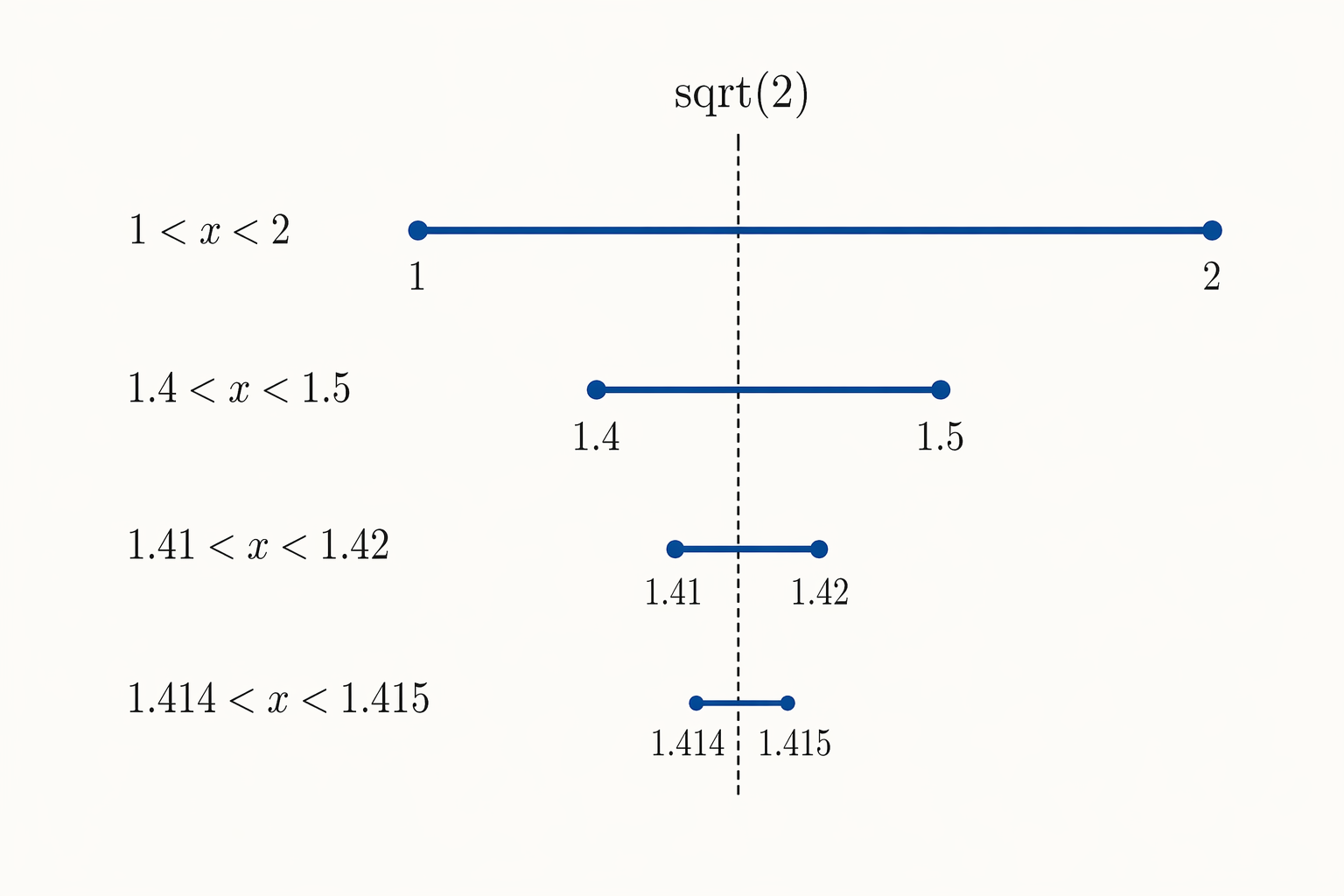
Figure. A decimal expansion does not merely list digits. It creates a chain of smaller and smaller rational intervals containing the target number.
Turning a decimal expansion into a cut
Define
and
Intuitively:
- contains every rational that is definitely to the left of some lower approximation,
- contains every rational that is definitely to the right of some upper approximation.
The claim is that (A,B) forms a Dedekind cut, and that this cut is the real
number represented by the decimal expansion.
So decimal notation is not being discarded. It is being absorbed into the cut-based model.
Why decimal strings are useful but not the primary definition
The previous note already hinted at the main problem with taking decimal strings as the primary definition of real numbers:
- the same real number can have more than one decimal expansion,
- for example
0.999...=1.
So decimal notation is excellent for intuition and approximation, but it needs a deeper structural interpretation. Dedekind cuts supply that interpretation.
Common mistake
A finite truncation is not the real number itself
The decimal 1.414 is not . It is only a rational approximation from
below. Likewise 1.415 is not the exact number either; it is an upper fence.
The real number is the boundary captured by the whole infinite approximation
process.
Build the interval chain interactively
Use the builder below to reveal one more decimal digit at a time and watch the lower bound, upper bound, and interval width update together.
Read and try
Build decimal approximations as shrinking intervals
The builder turns a decimal expansion into successive lower and upper rational bounds, making the approximation process visible one digit at a time.
Using sqrt(2) makes the link to irrational numbers explicit: no finite decimal stage reaches the exact number, but the intervals keep shrinking around it.
Step
3
Lower bound
1.414
Upper bound
1.415
Step 0
1 < x < 2
Interval width = 1
Step 1
1.4 < x < 1.5
Interval width = 0.1
Step 2
1.41 < x < 1.42
Interval width = 0.01
Step 3
1.414 < x < 1.415
Interval width = 0.001
Irrational numbers inside
Once the real numbers are constructed, define:
Definition
Irrational number
An irrational number is an element of .
This definition is short, but its meaning is deep. An irrational number is not “mysterious” or “unfinished”. It is a perfectly legitimate real number that is simply not represented by any rational cut.
The real number
Now consider the classical example
This cut defines the real number called .
The key idea is that the boundary between “rationals whose square is still
below 2” and “rationals whose square is already above 2” is exactly the
positive number whose square should be 2.
Worked example
Why is irrational in this model
Earlier in the course, you proved that no rational number has square 2. So
the boundary determined by the condition cannot be a rational cut.
That means the corresponding real number exists in the completed system , but not in the embedded copy of . Hence it is irrational.
This is one of the cleanest illustrations of why the real numbers are needed at all: the rational numbers describe the two sides of the boundary, but they do not contain the boundary point itself.
What decimals and irrationals are teaching you together
There are two compatible claims here.
- A real number can be approximated arbitrarily well by rationals.
- Some real numbers are nevertheless not rational.
Those statements do not conflict. In fact, they are exactly what makes the real number system powerful. Irrational numbers can be reached by rational approximations without ever turning into rational numbers themselves.
Quick checks
Quick check
What do the sets S and T do for a decimal expansion?
Answer in terms of lower and upper rational approximations.
Solution
Answer
Quick check
Why does the identity 0.999...=1 show that decimal strings are not ideal as the primary definition of reals?
Focus on uniqueness of representation.
Solution
Answer
Exercises
Quick check
Write the first four lower and upper rational fences suggested by the decimal 3.14159....
Begin with the integer interval and then reveal one more digit at each step.
Solution
Guided solution
Quick check
Why does the cut determined by define an irrational number rather than a rational one?
Use what was already proved about rational squares.
Solution
Guided solution
Related notes
Read this after 4.5 Dedekind cuts and the embedding of Q and 3.5 Gaps in Q and why sqrt(2) is not rational. Then continue to 5.1 Sequences and epsilon-N limits.