Chapter 5 now shifts from sequences to functions. The new difficulty is that a
sequence approaches its limit through the discrete parameter n, while a
function argument x can move toward a point a through infinitely many nearby
real values from both sides.
This is why the - definition is needed.
From sequence limits to function limits
In the previous chapter, the definition of
said that every small tolerance around can be achieved by going far enough out in the sequence.
For functions, we want an analogous sentence:
as x approaches a, the function value f(x) approaches .
But now “going far enough out” no longer makes sense. We need a new way to say
that x is close enough to a. That role is played by .
Open intervals and punctured domains
First specify the kind of domains involved.
Definition
Open interval
An open interval is a subset of of one of the forms
where and .
To define a limit at a point a, consider functions defined on an
open interval with the point a removed. That removal is important: a limit is
about what happens near a, not necessarily what happens at a.
The formal delta-epsilon definition
Definition
Limit of a function at a point
Suppose is an open interval containing , and let . We say
if and only if for every , there exists such that
Read the implication carefully:
- means
xis close toa, but not equal toa; - means the function value lands inside the -band around .
So the definition says:
every requested output accuracy can be guaranteed by forcing the input
xinto a sufficiently small punctured neighborhood ofa.
Common mistake
The limit definition ignores the value at a
The condition removes the point a itself. So f(a) may be
undefined, or may differ from , while the limit still exists.
First example:
The basic linear test case is the function at .
Worked example
Choosing
Let , , and . Then
So in order to force , it is enough to make
Therefore choose
Then whenever ,
Hence
This example shows the standard proof pattern:
- start with ,
- simplify it into an expression involving ,
- choose to make that expression smaller than .
Two more basic examples
Worked example
Constant functions
If for all x, then
for every and every x.
So any positive number can be chosen as , and
Worked example
A function with a hole
Consider
The formula is undefined at , but for it simplifies to
So near ,
Therefore choosing works. If , then
Hence
even though f(2) is not defined.
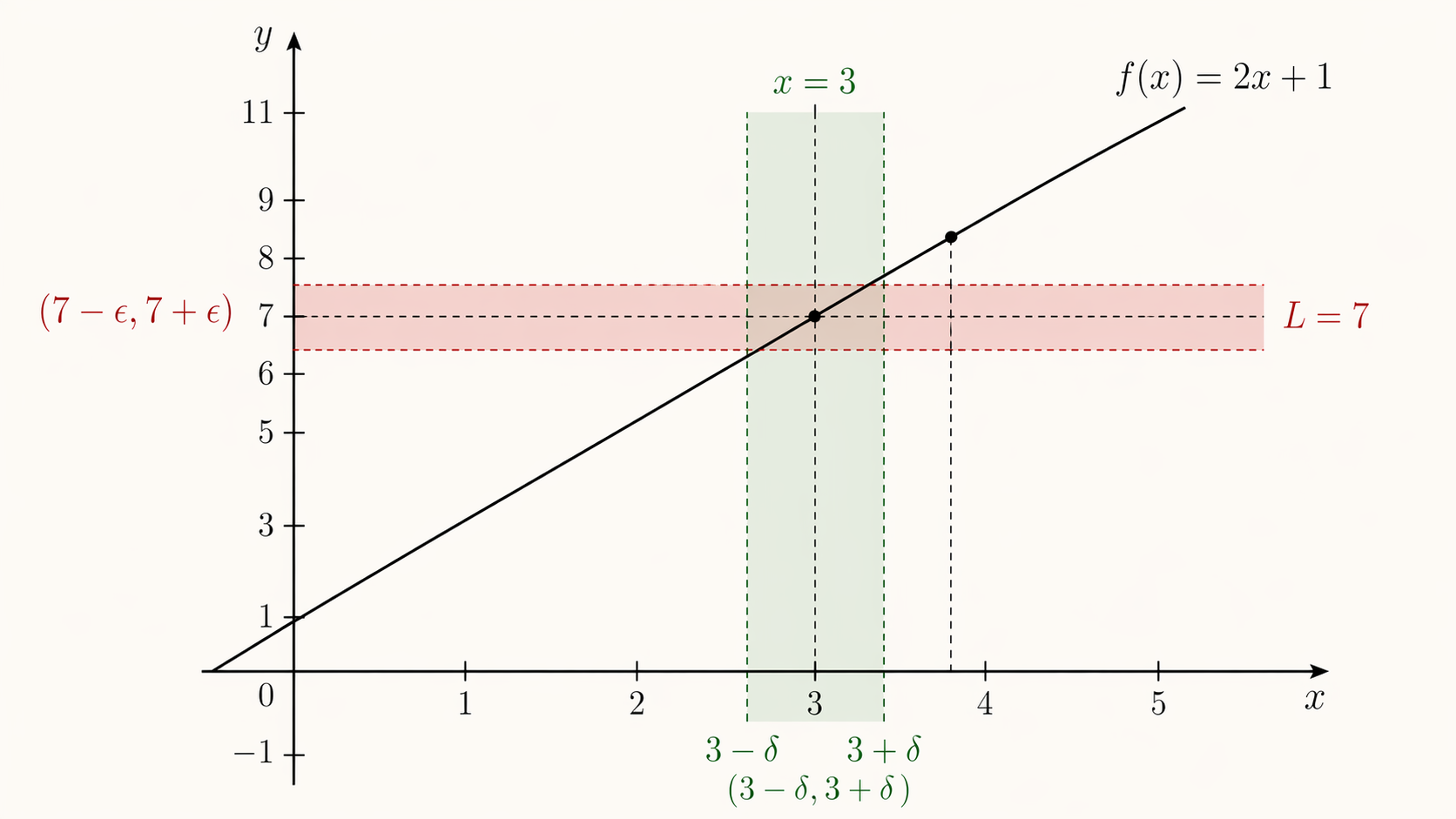
Figure. The - definition links an input neighborhood of
a to an output band around . The proof task is to choose so that
this implication always succeeds.
Explore the definition interactively
The explorer below lets you choose one of the examples, select
, and test sample inputs x. The point is to see the implication
as a relationship between an input strip and an output band.
Read and try
Check one delta-epsilon implication geometrically
The explorer links the x-side delta-condition and the y-side epsilon-condition so readers can see the formal implication as two coordinated geometric tests.
0 < |x - a| < δ, with δ = 0.25
3
x = 2.8
|f(x) - L| < ε, with ε = 0.5
7
f(x) = 6.6
0 < |x - a| < δ
|2.8 - 3| = 0.2
The chosen x really lies inside the delta-neighbourhood.
|f(x) - L| < ε
|6.6 - 7| = 0.4
The function value lands inside the epsilon-band around L.
How limits can fail to exist
Next, consider how to show that a proposed limit does not exist.
To prove , one must find a single such
that no matter how small is chosen, some point x with
still satisfies
Example 22 uses
which equals 1 for and for .
Worked example
Why has no limit at 0
Take . For any , choose
Then both satisfy , but
No single real number can lie within distance 1 of both 1 and .
Therefore the function has no limit at 0.
This example captures a common failure mode: left-hand and right-hand behavior do not agree.
Algebra of limits
Once some basic limits are known, limit laws show how to build new ones from old ones.
Theorem
Limit laws
If and , then:
- ,
- ,
- if , then
The proof of the sum law is the cleanest illustration: split the allowed error into two halves and use the triangle inequality,
The product law needs one extra idea: before estimating the product error, one
must first show that |f(x)| stays bounded near a.
Worked example
Using the sum law
Consider and near . Once the basic limits
are known, the sum law gives
The sequential characterization
The sequential criterion connects function limits back to sequence limits.
Theorem
Sequential characterization of function limits
Let . Then
if and only if for every sequence with for all
n and , we have
This theorem is extremely useful because it gives two complementary methods:
- to prove a limit exists, check every sequence approaching
a; - to prove a limit does not exist, find two sequences approaching
athat give incompatible output behavior.
Example 25 applies this idea to near 0.
Worked example
Two sequences proving that has no limit at 0
Take
Then and , but
while
Since two sequences approaching the same point produce different limiting function values, does not exist.
Continuity
One of the main purposes of limits is to make the idea of continuity precise.
Definition
Continuity at a point
Let and . The function f is continuous at a if
Equivalently, in - language:
Notice what changed: the condition disappeared. Continuity really does care about the function value at the point.
A standard discontinuous example is:
Here the nearby values are all 0, so the limit near 0 is not .
Therefore the function is discontinuous at 0.
Common mistake
A function can have a limit at a without being defined at a
The hole example shows this clearly. Limits are about nearby values. Continuity adds the extra requirement that the function is defined at the point and that its value agrees with the limit.
Quick checks
Quick check
Why does the function-limit definition use instead of only ?
Think about whether the value at a should matter for the limit.
Solution
Answer
Quick check
For the proof that , what choice of delta works for a given epsilon?
Use the identity .
Solution
Answer
Quick check
Why can have a limit at even though the formula is undefined there?
Recall what the limit definition does and does not inspect.
Solution
Answer
Exercises
Quick check
Prove that .
Rationalize and also keep x near 4 so the denominator stays away from zero.
Solution
Guided solution
Quick check
Use the sequential characterization to show again that does not exist.
You only need two carefully chosen sequences.
Solution
Guided solution
Quick check
What extra condition must be added to ‘the limit of f(x) as x approaches a exists’ in order to conclude that f is continuous at a?
Compare the definitions of limit and continuity.
Solution
Guided solution
Related notes
Read this after 5.1 Sequences and epsilon-N limits and 5.2 Cauchy sequences and another model of the reals. For the order-theoretic background behind completeness, see 4.3 Completeness and gaps in Q.