Why cuts are the next step
The previous note ended with a picture:
- a real number should determine everything in that lies to its left;
- it should also determine everything in that lies to its right;
- the real number itself should behave like the boundary between those two camps.
The next step is to turn that picture into a formal definition. The important move is this: instead of assuming the real number already exists and then asking what lies below it, we define the real number by the left-hand part of itself.
That is the basic idea of a Dedekind cut.
Two equivalent definitions
Definition
Dedekind cut as a pair
A Dedekind cut is a pair (A,B) of nonempty subsets of such that:
- ;
- for every and , we have ;
- has no maximum element.
In words, is the entire left side of the boundary, and is the entire right side. There is no overlap, nothing is missing, and the left side does not contain its own last point.
Definition
Dedekind cut as a single subset
Equivalently, a subset is called a Dedekind cut if:
- and ;
- whenever and satisfy , then ;
- for every , there exists with .
The second form is often easier to use. Once the left set is known, the right set is automatically . So the cut is completely determined by which rationals count as "already to the left of the boundary".
What each condition is doing
The definition is short, but every clause has a job.
- and prevent a fake cut with no left side or no right side.
- Downward closure says that if a rational is already on the left, then every smaller rational must also be on the left.
- The "no maximum" condition says the boundary itself is not stored as the last element of ; there is always room to move a little farther right while staying on the left.
This last point is the subtle one. It is exactly what prevents one rational number from being represented twice.
Worked example
The cut for
Let
Then and are both nonempty, every element of is smaller than every element of , and has no maximum.
To see the last point, start with any and define
Then , so and x was not maximal. Thus (A,B) is a
Dedekind cut. This cut is the rational number viewed inside the real
number system built from cuts.
Rational cuts and the embedding of
Call a cut (A,B) rational if has a minimum element. In that case the
boundary is already achieved by a rational number.
If , then necessarily
That motivates the notation
So each rational number q gives a Dedekind cut , and the map
embeds into the cut model of the reals.
Theorem
The rational numbers sit inside the cut model
Rational Dedekind cuts are in bijection with rational numbers. After this
embedding is established, it is standard to identify q with its cut .
In particular, and play the roles of 0 and 1 inside .
This matters conceptually. The cut construction is not trying to throw away the rationals and start from scratch. It is enlarging by adding new boundaries that were missing before.
Common mistake
Using instead of
The set is nonempty, proper, and downward closed, but
it fails the "no maximum" condition because q itself is the largest element.
If we allowed that set as well as , then the same rational number would be
represented in two different ways. The strict inequality is not cosmetic; it
removes that ambiguity.
Order and the first operations on cuts
Defining the set of all cuts is not enough. To match the target from the previous note, we must also define order and arithmetic on .
For order, the natural rule is:
This is exactly the right comparison for left sets. If every rational already on
the left of is also on the left of A', then the boundary represented by
cannot lie to the right of the boundary represented by A'.
For addition, define
The idea is that the left side of a sum should consist of rational numbers that can already be reached by adding something strictly left of the first boundary to something strictly left of the second boundary.
For multiplication, first handle the case of nonnegative cuts and then extend the definition by sign rules. When and , they use
This is more technical than addition, but the guiding idea is the same: build the left side of the product from rational data that already lies to the left.
Worked example
Why
Write
If and , then , so every element of lies in .
Conversely, if , then , and
So every rational in lies in . Hence
This example shows that the cut definition really extends the ordinary rational operations rather than inventing new arithmetic.
Theorem
The cut model reaches the target from 4.4
Define , , and on Dedekind cuts and then check that the resulting structure is a complete ordered field containing the embedded copy of .
The proofs are not short, but the overall message is clean: Dedekind cuts do exactly what chapter 4 asked a model of the real numbers to do.
Seeing the boundary on the number line
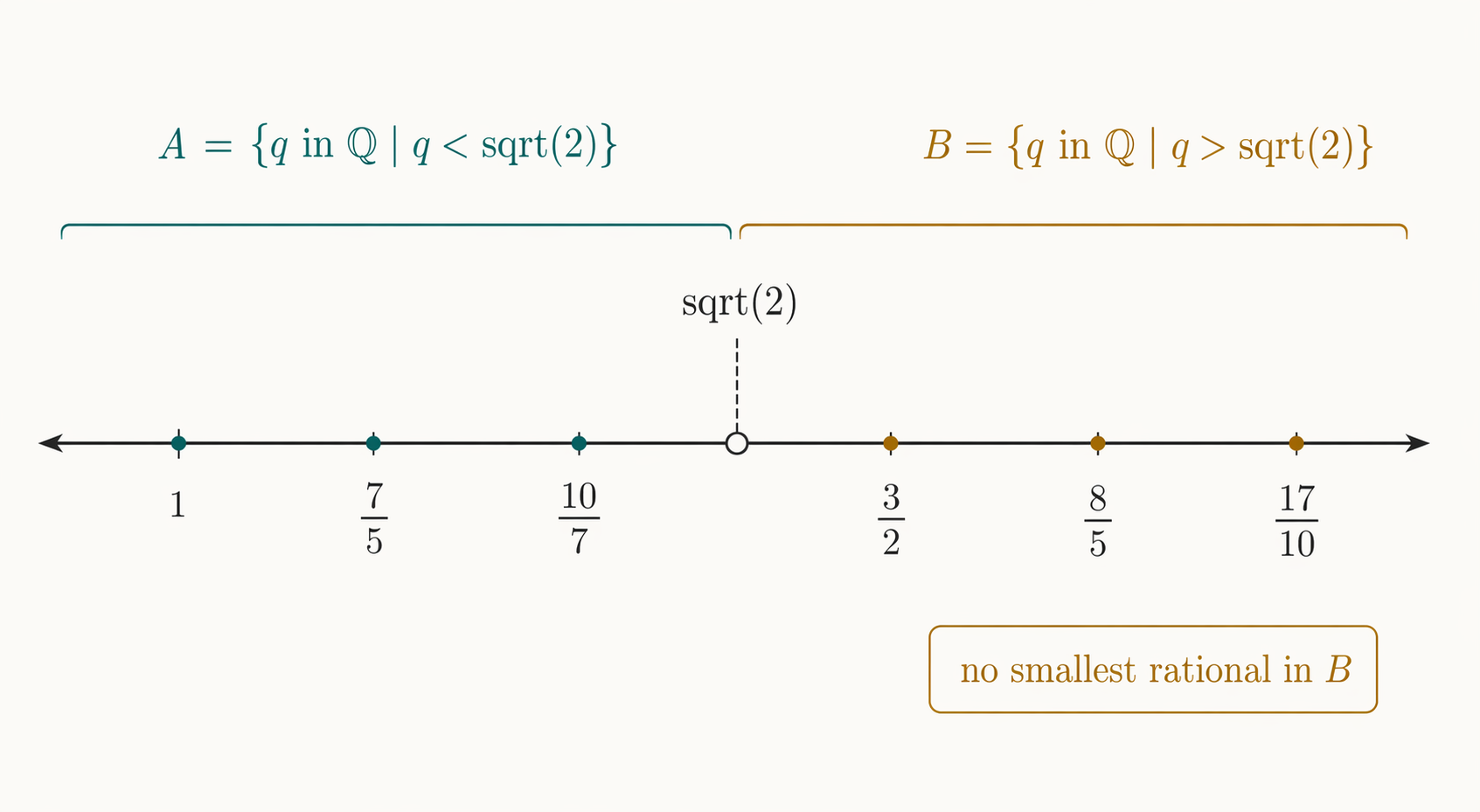
Figure. A cut stores every rational to the left of a boundary. When the boundary is , the right side has no smallest rational element.
Compare rational and irrational cuts interactively
The explorer below places the rational boundary next to the irrational boundary . The key structural question is whether the right-hand side starts with a least rational element.
Read and try
Inspect the two sides of a Dedekind cut
The explorer splits sample rationals into the left and right sides of a Dedekind cut so readers can see the structural difference between rational and irrational cuts.
What to notice
No rational equals sqrt(2), so the rationals to the right never start with a smallest one. This is the signature of an irrational cut.
A = { q ∈ Q | q < sqrt(2) }
B = { q ∈ Q | q > sqrt(2) }
1
A
6/5
A
7/5
A
10/7
B
3/2
B
8/5
B
17/10
B
sqrt(2)
Set A
1, 6/5, 7/5
Every displayed element is strictly left of sqrt(2), and more rationals can always be inserted still closer to the boundary.
Set B
10/7, 3/2, 8/5, 17/10
No rational equals sqrt(2), so the rationals to the right never start with a smallest one. This is the signature of an irrational cut.
Common mistakes
Common mistake
The pair version and the subset version are not two different theories
They describe the same object from two angles. The pair (A,B) records both
sides of the boundary explicitly, while the subset form keeps only the left
side and recovers the right side as .
Common mistake
Order on cuts is not a comparison between every element of two sets
The statement means . It does not mean that every
element of is less than every element of A'. The two left sets usually
overlap heavily, especially when one boundary lies to the left of the other.
Quick checks
Quick check
What is the cut ?
Write it directly from the definition .
Solution
Answer
Quick check
If , which boundary lies to the left?
Answer in terms of the cut order.
Solution
Answer
Exercises
Quick check
Show that is a Dedekind cut for every rational number q.
Check the three conditions in the subset definition.
Solution
Guided solution
Quick check
Why is not a Dedekind cut, even though it is nonempty, proper, and downward closed?
Identify the exact condition that fails and explain why it matters.
Solution
Guided solution
Related notes
Read this after 4.4 Axioms for the reals and first approximations. Then continue with 4.6 Decimal expansions and irrational numbers, which reconnects cuts with familiar decimal notation and introduces as an irrational cut.