Chapter 6 has already used bijections, injections, surjections, countability, and the Axiom of Choice to compare sizes of sets. The final part of the chapter makes an important warning explicit:
there is no single mathematical meaning of the word "large".
An interval can be short in length but as large as in cardinality. The Cantor
set can have total removed length 1 and still have the same cardinality as the
real line. The rationals are countable, yet dense in . The natural numbers are
well-ordered, while the integers and positive rationals are not well-ordered by
their usual orders.
These are not contradictions. They are different structures asking different questions.
Closed intervals and half-closed intervals
We have already used open intervals such as (a,b). Now add the
closed version.
Definition
Closed interval
Let with . The closed interval from a to b is
The endpoint convention matters:
(a,b)excludes both endpoints;[a,b]includes both endpoints;[a,b)includesabut excludesb;(a,b]excludesabut includesb;- and are defined analogously.
This notation matters because later constructions often depend on whether endpoints remain present. That will matter immediately for the Cantor set: at each stage, closed intervals remain, so their endpoints are not removed.
Common mistake
Do not treat interval notation as decoration
The intervals (0,1) and [0,1] differ as subsets of . They have the same
cardinality, but they are not the same set. In proofs, first decide whether you
are proving equality of sets, equality of cardinalities, or a statement about
length.
Intervals and cardinality
The interval (0,1) has the same cardinality as .
Theorem
The interval (0,1) has cardinality |R|
There is a bijection
Verifying that this function is bijective is a useful exercise.
The proposition is deliberately striking. The interval (0,1) looks bounded and
short, while is unbounded in both directions. Cardinality ignores metric
length and only asks whether the elements can be paired off exactly.
Worked example
Why boundedness does not control cardinality
The open interval (0,1) is bounded in the usual order and metric on . The
real line is not bounded. Nevertheless, the displayed function gives a
one-to-one and onto correspondence between them.
So the statement
does not mean the two sets have the same length. It means there exists a bijection between their elements.
A useful exercise is to show that all intervals have the same cardinality. For non-degenerate finite intervals, the first reduction is linear:
maps (a,b) bijectively onto (0,1) when . Half-infinite and infinite
intervals can then be compared to (0,1) through explicit bijections of the same
kind as the proposition above.
The lesson is that interval length and interval cardinality are measuring different things.
The Cantor set construction
The Cantor set is introduced to push this distinction further.
Start with
At each later stage, remove the open middle third of every interval that remains.
-
Stage
0: -
Stage
1: remove , leaving -
Stage
2: remove the middle third from each of the two intervals in , leaving -
Stage
n: is the union of closed intervals, each of length .
Definition
Cantor set
The Cantor set is the common intersection
The sets are nested:
This nesting is why the intersection is a meaningful object. A point belongs to exactly when it survives every stage of middle-third removal.
Worked example
Endpoints survive
At stage 1, the open interval is removed, but the endpoints and stay.
At later stages, endpoints of remaining closed intervals again stay. Therefore points such as
are not removed at the stage where they first appear as endpoints.
Ternary expansions and membership in
Next give an arithmetic description using base 3.
Every can be written in ternary form
As in decimal notation, representations are not always unique. For example, just
as 0.999...=1 in base 10, one has
Use the non-terminating expansion when possible. With that convention:
- removing removes exactly the numbers whose first ternary digit is
1; - stage
2removes numbers whose second ternary digit is1; - in general, the Cantor set consists exactly of numbers in
[0,1]that can be written in ternary using only the digits0and2.
Theorem
Ternary description of the Cantor set
With the non-terminating ternary convention, a point belongs to if and only if it has a ternary expansion
where every digit is either 0 or 2.
This description is useful because it replaces a geometric removal process by a
digit rule. Surviving every stage is the same as never using the digit 1 in the
ternary expansion.
The length paradox
The construction removes many intervals. At stage 1, it removes one interval
of length . At stage 2, it removes two intervals of length . At
stage n, it removes
intervals, each of length
The total removed length is therefore
Since [0,1] has length 1, this calculation suggests that the remaining set
should be extremely small. In the language of length, the Cantor set has no
length left after the removals.
But length is still not cardinality.
The Cantor set has cardinality |R|
In fact, the Cantor set is not merely non-empty. It is uncountable, and in fact has the same cardinality as .
Theorem
The Cantor set has the same cardinality as
Let be the set of all infinite binary sequences
Define
This sends a binary sequence to the ternary expansion whose kth digit is
0 if and 2 if . Thus the image lies in .
This is a bijection. Since the set of infinite binary
sequences has cardinality , and this cardinality is |R|, it follows that
Common mistake
Zero length does not mean countable
The Cantor set is often described as dust because it is produced by removing open intervals at every scale. But the cardinality theorem says it still has as many points as the real line. Length and cardinality are different measurements.
View the stages
The stage viewer below is meant to support the construction, not replace the definition. Use it to compare the interval picture with the formulas for and with the ternary digit rule.
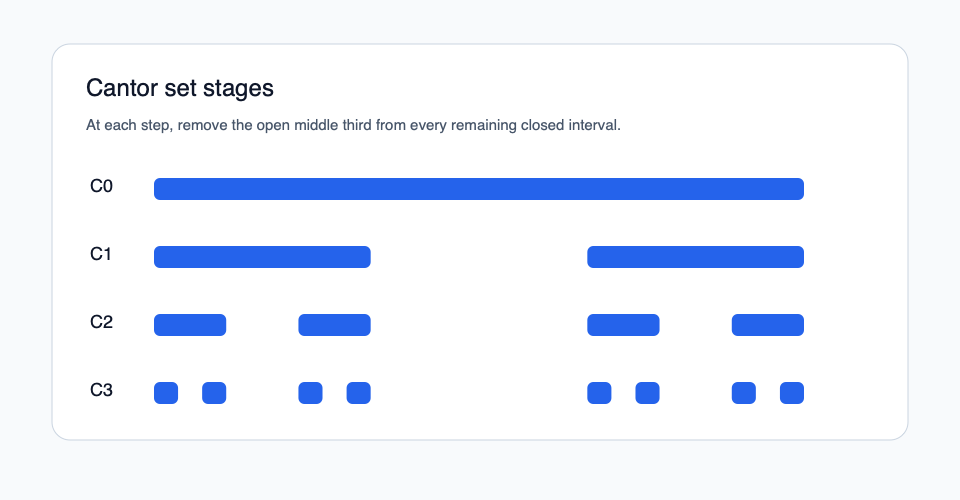
Figure. Each stage removes the middle third from every interval that survived the previous stage.
Read and try
Step through the Cantor set construction
The viewer shows how repeated middle-third removal creates a set that is small by length but large by cardinality.
Stage
C_0
Remaining intervals
1
Removed length so far
0
The limit set keeps exactly those points that can be written in ternary using only the digits 0 and 2.
Density in the real line
The next section introduces a different notion of largeness.
Definition
Dense subset of
A subset is dense if for every and every , there exists such that
This definition does not ask how many elements has. It asks whether elements of can approximate every real number arbitrarily well.
Equivalently, no matter where you stand on the real line and no matter how small a tolerance you choose, some element of lies within that tolerance.
Integers are not dense
Theorem
is not dense in
Take
For every integer n,
So no integer lies within distance of . Hence is not dense in .
The proof only needs one failed target point and one failed tolerance. To show that a set is not dense, you do not have to check every real number. You only need to find a gap that the set cannot enter.
Rationals are dense
Theorem
is dense in
Let and let . By the Archimedean property, choose such that
Choose the largest integer satisfying
Then
Dividing by n gives
Thus
satisfies . Therefore is dense in .
This proof shows exactly what density means: for any requested tolerance, a rational approximation can be chosen inside that tolerance.
Common mistake
Dense does not mean uncountable
The rationals are dense in , but earlier cardinality results show that is countable. Density measures approximation, not cardinality.
The same idea can be restricted to a subset of the real line.
Definition
Dense in a subset
Let . A subset is dense in if for every and every , there exists such that
Well-ordering
The last part of Chapter 6 turns from size and approximation to order.
Definition
Well-ordered set
Let be a totally ordered set. We say is well-ordered if every non-empty subset has a minimum.
This is stronger than merely being totally ordered. A total order lets you compare two elements. A well-order additionally says that every non-empty subcollection has a first element.
Worked example
Finite initial segments of
In the von Neumann construction, a natural number n is identified with
Ordered by inclusion, this is the usual order on the finite initial segment.
Every non-empty subset has a least element, so each finite n is well-ordered.
Theorem
The natural numbers are well-ordered
The usual order on is a well-order: every non-empty subset of has a minimum.
The proof is by contradiction using induction. If a non-empty subset had no minimum, induction would show that , then , then , and so on. Hence no natural number would lie in , contradicting non-emptiness.
Orders that are not well-orders
Theorem
is not well-ordered by the usual order
The subset has no minimum. For any , the integer also lies in and satisfies . Therefore no element can be first.
Theorem
is not well-ordered by the usual order
The subset has no minimum. For any positive rational q, the number
is also positive rational and satisfies .
The second example is especially important because all elements are positive. The failure is not caused by negative numbers. It is caused by an infinite descending process with no first positive rational.
Common mistake
A minimum is not the same as a lower bound
The set has lower bounds in , such as 0, but . A
minimum of a set must belong to the set itself.
Countable sets can be well-ordered
Now separate two statements:
- a particular order may fail to be a well-order;
- the underlying set may still admit some other well-order.
Theorem
Every countable set can be well-ordered
If is finite, list it as
and order the elements by their indices.
If is countably infinite, choose a bijection
Define
This transports the well-ordering of to .
For example, is not well-ordered by its usual order, but it is countable, so it can be well-ordered by choosing an enumeration of its elements.
The Well-Ordering Theorem
The chapter ends by connecting well-ordering to the Axiom of Choice.
Theorem
Well-Ordering Theorem
The Axiom of Choice is equivalent to the statement:
every set can be well-ordered.
One direction is direct. If every set can be well-ordered, then for a family of non-empty sets, well-order the union and choose from each member its least element. That gives a choice function.
The other direction uses the Axiom of Choice to choose an element from every non-empty subset of , then tries to build an order by repeatedly choosing the next unused element. This direction is more technical because making the construction precise requires transfinite recursion, which is beyond the course.
Common mistake
The Well-Ordering Theorem is not saying the usual order works
The usual order on , , or may fail to be a well-order. The theorem says that some well-order exists, assuming the Axiom of Choice. It does not give a familiar or computationally useful order.
Quick checks
Quick check
At stage n of the Cantor construction, how many intervals remain and what is the length of each one?
State both quantities in terms of n.
Solution
Answer
Quick check
Why does the proof that is not dense only need to examine and ?
Use the definition of not dense.
Solution
Answer
Quick check
Why is dense in even though is countable?
Name the two different ideas being compared.
Solution
Answer
Quick check
Why is the usual order on not a well-order?
Identify a non-empty subset with no minimum.
Solution
Answer
Exercises
Quick check
Use the ternary description to decide whether lies in the Cantor set.
Explain which digits matter.
Solution
Guided solution
Quick check
Prove that is not well-ordered by its usual order.
Use the same ternary-expansion idea.
Solution
Guided solution
Quick check
Let be countably infinite and let be a bijection. Why does the transported order on become a well-order?
Use the well-ordering of .
Solution
Guided solution
Related notes
Read this after 2.2 Functions and relations, 4.2 Upper bounds, supremum, and infimum, and 4.3 Completeness and gaps in Q. Then continue to 7.1-7.2 Binary operations, monoids, and groups.